
The Model That Never Learned
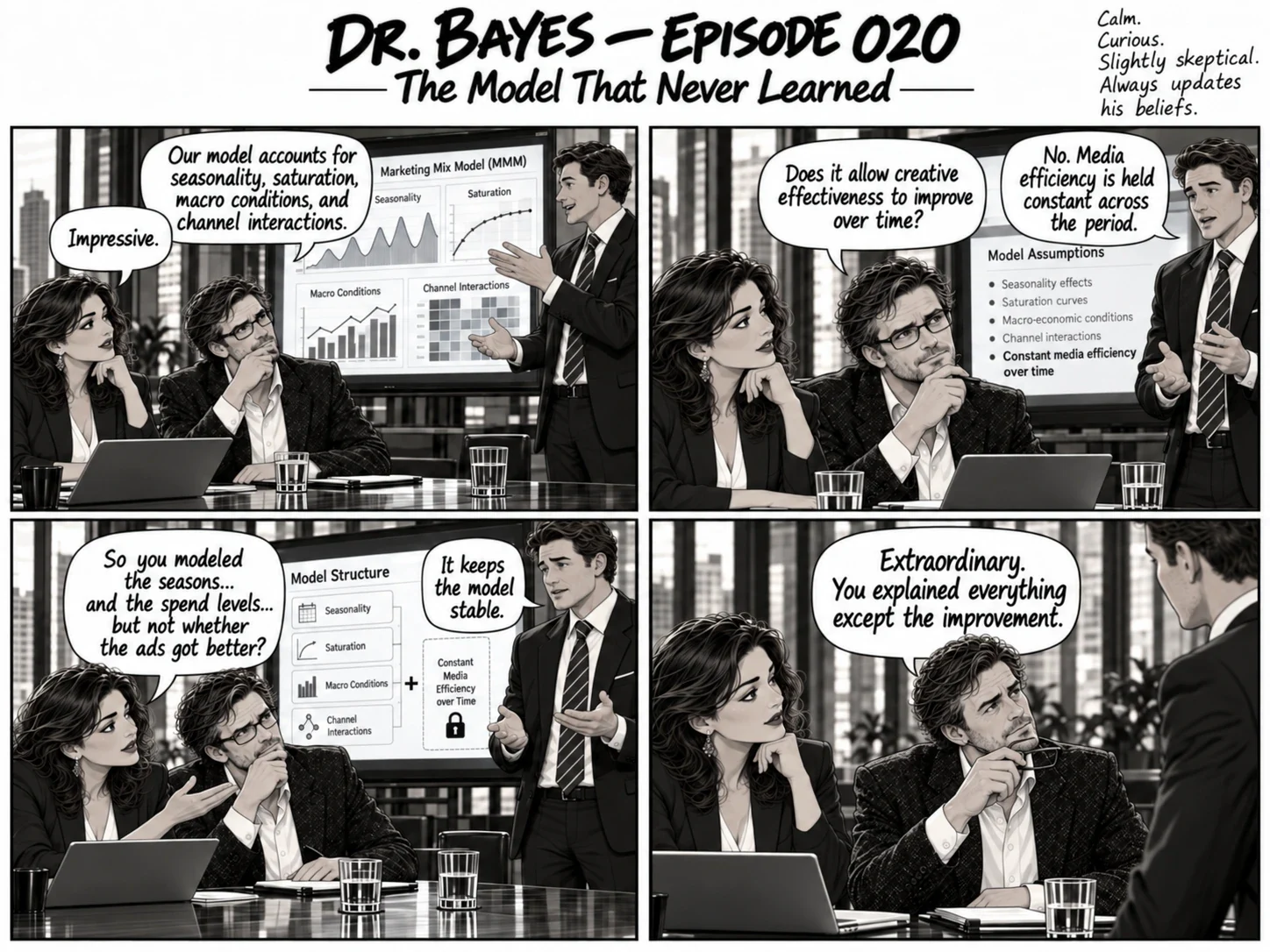
Every factor accounted for, except one. An agency presents a marketing mix model that handles seasonality and saturation but assumes creative effectiveness never changes. Dr. Bayes and Elena notice.




Behind the joke.
Seasonality describes recurring calendar patterns in demand, and saturation describes diminishing returns as spend rises. A model can capture both while still assuming that the underlying response to each unit of media never changes. If the creative genuinely improved, a constant media coefficient has nowhere to put that change, so it is averaged away or credited to other factors. Letting the effect vary over time allows the data to show whether the ads actually got better; stability bought by assumption is not evidence.
The transcript.
For readers who prefer dialogue without zooming in.
Read the dialogue ↘
Consultant: Our model accounts for seasonality, saturation, macro conditions, and channel interactions.
Elena Reyes: Impressive.
Dr. Bayes: Does it allow creative effectiveness to improve over time?
Consultant: No. Media efficiency is held constant across the period.
Elena Reyes: So you modeled the seasons... and the spend levels... but not whether the ads got better?
Consultant: It keeps the model stable.
Dr. Bayes: Extraordinary. You explained everything except the improvement.